A downtown newsletter is the one marketing channel a Main Street organization fully owns. Social platforms decide who sees your posts. An email list goes straight to the inboxes of the residents, shoppers, merchants and sponsors who asked to hear from you. Sent on a steady schedule with useful local news, a main street newsletter can fill event calendars, support new businesses, keep people informed during construction, and give sponsors something real to put their name on. This guide covers what to send, how to build the list, how often to send, and how to measure it.
We build and run newsletters for local publishers and organizations across New Jersey, and The Hype Hero is a Professional Affiliate of the Connecticut Main Street Center. Everything below comes from that work and from published, verifiable research.
Key takeaways
- A newsletter is the one channel your downtown fully owns. No algorithm decides who sees it.
- Lead every issue with events, then new businesses, a merchant spotlight and practical updates.
- Grow the list with QR codes at events, signup cards at merchant counters and a website form.
- Send monthly on a fixed day. Consistency beats frequency.
- Judge results by clicks, list growth and real world outcomes, not open rates alone.
- Keep shoppers and merchants on separate lists, and offer sponsors a clear, labeled placement.
Why should a downtown organization have a newsletter at all?
Because your downtown needs a direct line to its community that nobody else controls. Main Street America describes the Promotion point of its Main Street Approach as work that “positions the downtown or commercial district as the center of the community and hub of economic activity, while creating a positive image that showcases a community’s unique characteristics.” A newsletter is one of the most practical ways to do that week after week. (Main Street America)
A newsletter for downtown organizations does a few jobs at once:
- It tells people what is happening, so they show up.
- It introduces new and existing businesses to the people most likely to try them.
- It keeps residents informed when parking, traffic or construction changes affect their visit.
- It shows sponsors, partners and local officials that the organization has an engaged audience.
- It builds a record of everything the organization does, issue by issue.
Running a nonprofit instead? Read our companion guide, why a newsletter can change everything for your nonprofit.
Why does email beat relying on social media reach?
Social media is useful for discovery, but you rent that audience. The platform decides how many of your followers see a post, and that can change without notice. Email is different. When someone subscribes, your message lands in their inbox, and you keep that list even if a platform changes its rules.
The engagement numbers are also strong for community organizations. Mailchimp’s published email benchmarks list an average open rate of 40.04% and an average click rate of 3.27% for nonprofits, compared with 35.63% and 2.62% across all users. Government senders posted the highest open rate in that dataset at 40.55% and the highest click rate at 4.58%. Community and civic audiences read their email. (Mailchimp email marketing benchmarks)
Email also pays back the effort. Litmus reports that 35% of the companies it surveyed see a return of 10:1 to 36:1 on email marketing, and another 30% see 36:1 to 50:1. Litmus also found that newsletters drive the highest ROI of any email type for agencies and professional services. (Litmus, The ROI of Email Marketing)
We see the same thing in our client work. The Rockaway Rundown, the weekly email we built for Rockaway News, has opened above 50% since its second issue. You can read how we did it in the Rockaway News case study.
None of this means you should stop posting on social. Use social to reach new people and invite them to subscribe. Use email to keep them.
What should a downtown newsletter include?
The best downtown newsletters answer one question for the reader: “Why should I come downtown this month?” Build each issue from these core sections.
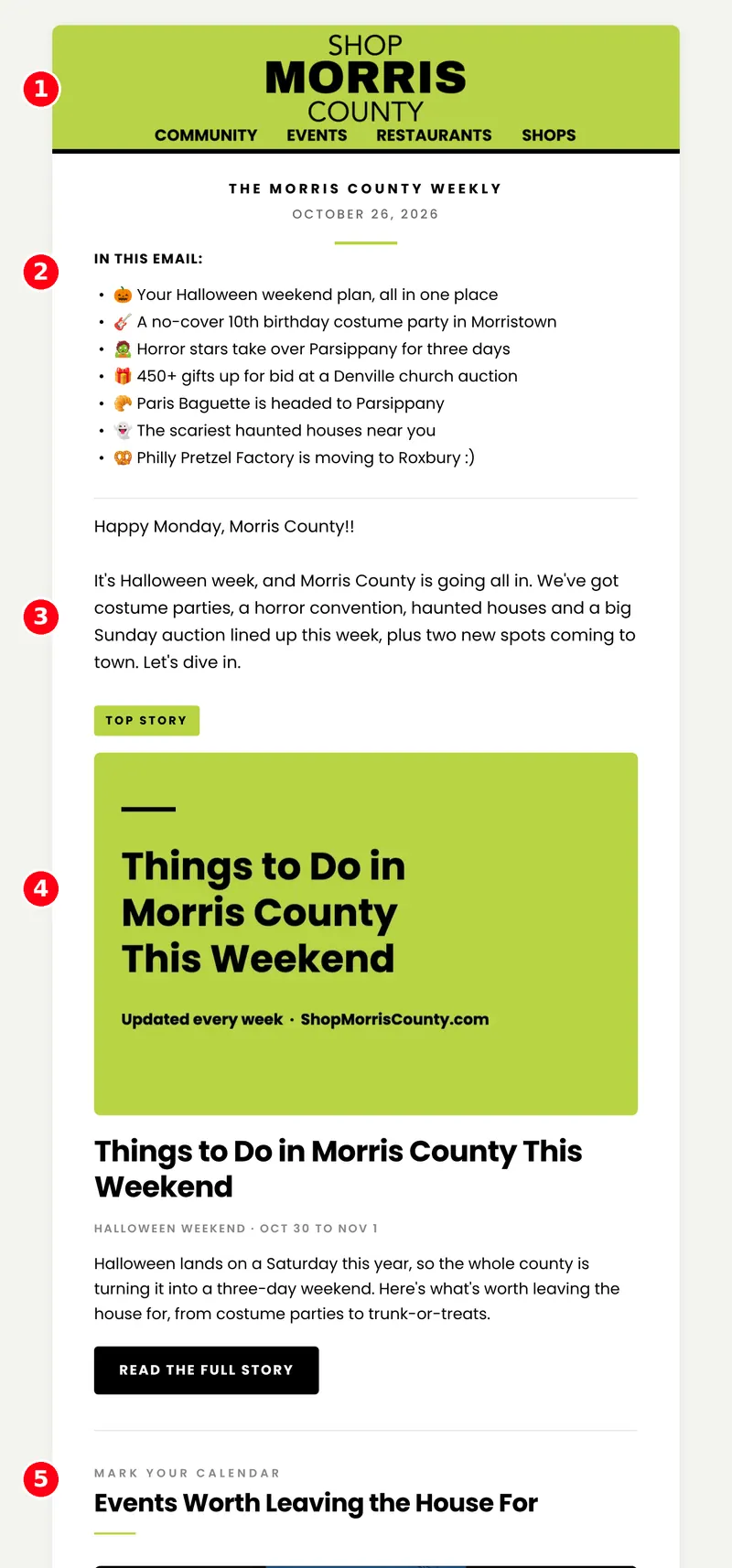
What this example gets right
- Branded header with clear sections. Readers know who it is from in one glance.
- “In this email” list. Every story is summarized up top, so skimmers find what they want.
- A short, friendly intro. Two or three sentences set the tone for the week.
- One top story with one button. The biggest item gets the most space and a single call to action.
- An events calendar. Dates, towns and a “read more” link for each event make planning easy.
Upcoming events
Events are the reason most people open a downtown email. List the next four to six weeks of events with the date, time, location and one line on why it is worth attending. Link each one to a full event page or registration link. Put the biggest event at the top with a photo.
New business openings
A new shop or restaurant opening is genuine news. Give each one a short welcome with what they sell, where they are, and their hours. This helps the business get early customers and shows merchants that joining the district has visible benefits.
Merchant spotlights
Pick one business per issue and tell its story: who owns it, how long it has been there, what makes it different, and one thing readers should try. Rotate through the district so every merchant gets a turn. Spotlights are often the most forwarded part of a Main Street newsletter, because owners share them with their own customers.
Parking, traffic and construction updates
Nothing keeps people away like confusion. If a lot is closed, a street is torn up, or a detour is in place, say so clearly and say how to get downtown anyway. Pair the bad news with good news: “The sidewalk work on Main is finishing this month, and every shop is open. Park behind the library and walk two minutes.”
Sponsor recognition
Thank the businesses and partners who fund your work in every issue. A short, consistent sponsor section rewards current supporters and quietly shows prospective sponsors what they would get.
Volunteer and participation calls
Downtown organizations run on volunteers. Use one short block per issue to ask for help with a specific event, committee or project, with a clear signup link and a deadline.
Optional extras
Depending on your district, you might also add seasonal shopping guides, a photo from last month’s event, a short note from the director, public art and design project updates, or a “did you know” history item about a downtown building.
How do you build a downtown newsletter list?
You build it everywhere people already meet your downtown. A list is not something you buy. It grows from consistent, easy invitations.
QR codes at every event
Put a QR code on event signage, tables, stage banners and printed maps that goes straight to a short signup form. Offer a simple reason to join: “Get the monthly downtown events list.” Have a volunteer with a tablet at the info booth during big events.
Merchant counters
Ask participating merchants to keep a small table tent or card with your QR code by the register. Merchants benefit because the newsletter promotes them, so most are happy to help. Make the card small, attractive and easy to replace.
Website and social signup
Add a clear signup form to your website home page, your events page and your footer. Link to it from every social profile and pin a signup post. Keep the form short: an email address and first name are enough to start.
Partners and local media
Ask the town, the chamber, the library, schools and local news outlets to share your signup link when they promote downtown events. Cross promotion with partners can grow a list faster than anything you do alone.
Permission and trust
Only add people who asked to join, and make unsubscribing easy. A smaller list of people who want your email is far more valuable than a large list of people who never asked for it.
Work with The Hype Hero for your Main Street marketing
We’ll handle your downtown newsletter from start to finish.
How often should a Main Street newsletter go out?
For most downtown organizations, monthly is the right starting point for the public newsletter. It is frequent enough to stay top of mind and realistic for a small staff or volunteer team. If you have a busy events season, you can move to twice a month during that stretch.
Beyond the regular issue, send short extra emails only when something is time sensitive: a weather cancellation, a road closure, or a last call for a major event. Keep those rare so readers know they matter.
The most important rule is consistency. Pick a day, such as the first Tuesday of each month, and send on that day. Readers start to expect it, and your team gets a predictable production rhythm.
What makes a good subject line for a downtown newsletter?
Your subject line should tell readers exactly what is inside and why it is worth opening now. Mailchimp’s guidance is to keep subject lines to no more than nine words and 60 characters, use no more than three punctuation marks, and use no more than one emoji. (Mailchimp)
Patterns that work well for downtown newsletters:
- Lead with the biggest event: “Holiday Stroll is Saturday, plus 3 new shops”
- Use the town name: “What’s new in downtown Rockaway this month”
- Be specific and local: “Main Street reopens Friday: where to park”
- Feature a person: “Meet the baker behind Main Street’s new cafe”
Use the preview text, the short line shown after the subject in most inboxes, to add a second reason to open. Avoid vague subject lines like “October Newsletter,” which give readers nothing to act on.
How do you measure whether a downtown newsletter is working?
Measure what connects to your goals: attendance, foot traffic, merchant support and sponsor value. Track these numbers every issue:
- List growth: new subscribers minus unsubscribes, by month and by source (events, counters, website).
- Click rate: the share of recipients who clicked at least one link. This is your most reliable engagement number.
- Top links: which events, businesses and stories got the most clicks. This tells you what to feature next time.
- Unsubscribes and complaints: a sudden rise usually means you sent too often or sent something off topic.
- Replies: people who hit reply are your most engaged readers. Track and answer them.
- Real world outcomes: event registrations from newsletter links, redemptions of a newsletter only offer, or a merchant telling you a spotlight brought in new customers.
Treat open rates as a rough trend line. Mailchimp notes that Apple Mail Privacy Protection can inflate open rates, so clicks and outcomes are better proof. Share a simple one page report with your board and sponsors each quarter.
Should merchants and the public get separate newsletters?
In most cases, yes. The two audiences want different things.
The public newsletter is for residents, shoppers and visitors. It should feel like a guide to enjoying downtown: events, new businesses, spotlights, parking help and things to do. Keep it upbeat and visual.
The merchant newsletter is for business owners and managers in the district. It is practical: upcoming promotions they can join, sign up deadlines for events, construction schedules, grant or facade program news, training, safety notices, and meeting dates. It can be plain and short.
Mixing the two makes both worse. Shoppers do not want to read about vendor deadlines, and merchants do not need a list of family friendly weekend activities. If you only have capacity for one newsletter right now, start with the public one and send merchants a short update email when needed.
Can a downtown newsletter generate sponsor revenue?
Yes. A newsletter that reaches a steady, local, engaged audience every month is something sponsors understand and value. It also gives your organization a sponsorship benefit you control completely.
Common newsletter sponsorship options for downtown organizations:
- Presenting sponsor: one business or bank is named at the top of every issue for a season or a year.
- Featured sponsor block: a logo, short message and link placed mid newsletter.
- Event sponsor recognition: sponsors of a specific event are recognized in every issue promoting it.
- Bundled packages: newsletter placement included with event, banner and website sponsorship levels.
Keep sponsor content clearly labeled and limited to a few placements, so the newsletter still feels like community news. After each campaign, send sponsors a short report with the number of issues, the audience size, and the clicks their placement received. Sponsors renew when they can see results.
What does a simple monthly downtown newsletter template look like?
Here is a template any downtown or Main Street organization can use. Most issues take a reader two to three minutes.
- Header: your logo, the issue month, and a presenting sponsor line if you have one.
- Short intro (two or three sentences): the single most important thing happening downtown this month.
- Featured event: one large photo, the date, time, place and a button to learn more.
- Events calendar: four to six more upcoming events, one line each with a link.
- Welcome to downtown: new business openings with address and hours.
- Merchant spotlight: one business, a photo of the owner, and a short story.
- Getting downtown: parking, traffic or construction updates, only when needed.
- Get involved: one volunteer or committee ask with a signup link.
- Thank you to our sponsors: logos or names with links.
- Footer: social links, website, mailing address, and an easy unsubscribe link.
Build this template once in your email platform and reuse it every month. Your team then only needs to update content, not redesign the layout.
What does a good downtown newsletter look like compared with a bad one?
Here is a quick side by side. Use it as a checklist before you hit send.
✓ Good newsletter
- Subject line names the biggest event or story
- Opens with a short “in this email” list
- Short sections, each with one clear link or button
- Real photos of your streets, events and owners
- Sent on the same day every month
- Single column layout that reads well on phones
- Sponsors thanked in a clearly labeled section
- Results tracked by clicks and outcomes
✗ Bad newsletter
- Subject line says only “October Newsletter”
- Starts with a long letter from the organization
- Wall of text with links buried in paragraphs
- Stock photos or no images at all
- Sent whenever someone finds the time
- Wide, multi column layout that breaks on mobile
- Ads mixed into stories with no labels
- Nobody looks at the numbers
What are the most common downtown newsletter mistakes?
- Sending inconsistently. A newsletter that appears three times one month and then disappears for a season loses its readers. Pick a schedule you can keep.
- Making it too long. If every committee gets a full article, nobody reads to the end. Keep sections short and link out for details.
- Writing for the organization instead of the reader. Meeting minutes and internal updates belong in the merchant or board email. The public newsletter should answer “why come downtown?”
- No clear calls to action. Every section should give the reader something to do: register, visit, volunteer or learn more.
- Too few photos, or poor ones. Downtown is visual. Use real photos of your streets, events and business owners.
- Ignoring mobile. Many readers open email on their phones. Use a single column layout, large buttons and readable text.
- Not collecting signups at events. Every event without a QR code is a missed chance to grow the list.
- Never measuring. If you do not look at clicks and outcomes, you cannot show the board or sponsors what the newsletter delivers.
How can The Hype Hero help your downtown with its newsletter?
The Hype Hero plans, writes, designs and sends newsletters for local organizations and publishers, including the Rockaway Rundown for Rockaway News. We can set up your template, build your signup forms and QR codes, write each issue, manage sponsor placements and report results. We are a Professional Affiliate of the Connecticut Main Street Center and work with downtowns and Main Street organizations on promotion and digital marketing.
Learn more about our Main Street marketing services and our email newsletter marketing service, or see the results in the Rockaway News case study.
Frequently asked questions about downtown newsletters
How often should a downtown organization send a newsletter?
Most downtown and Main Street organizations do well with one public issue per month, plus short extra sends when something time sensitive comes up, such as a street closure or a big event weekend. Consistency matters more than frequency. Pick a day and keep it.
What should a Main Street newsletter include?
A strong Main Street newsletter usually covers upcoming events, new business openings, a merchant spotlight, parking or construction updates, sponsor recognition, and a volunteer or participation ask. Lead with what helps readers plan a visit.
How do we grow a downtown newsletter list from zero?
Put a QR code signup on event signage and table tents, ask merchants to keep a small signup card at the counter, and add a clear signup form to your website and social profiles. Every event is a list building event.
Should merchants and the public get the same newsletter?
Usually not. Shoppers want reasons to visit. Merchants want operational news, deadlines, training and partnership opportunities. Two short, focused newsletters perform better than one long mixed one.
Can a downtown newsletter bring in sponsor revenue?
Yes. A newsletter with a steady, engaged local audience is a sponsorship asset. Offer a presenting sponsor line, a featured sponsor block, or event sponsor recognition, and report real results back to sponsors.
How do we know if our newsletter is working?
Track list growth, click rate, which links get clicked, unsubscribes, replies, and event or promotion outcomes you can tie to a specific link or code. Treat open rates as a rough signal only, since privacy features in some email apps inflate them.
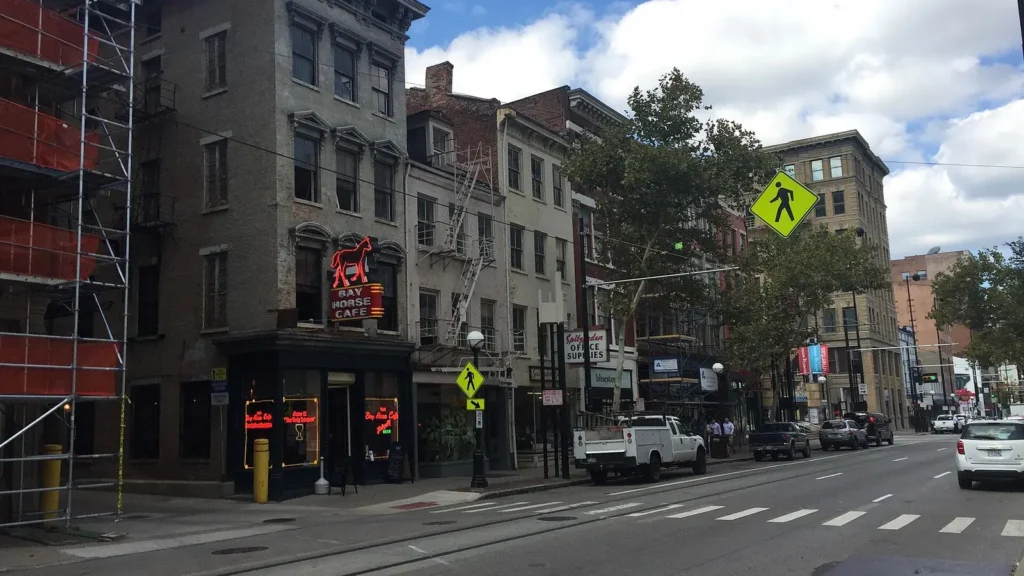
Featured photo: Main Street Historic District, Cincinnati, OH, by Warren LeMay, CC0, via Wikimedia Commons.
Want more calls from Google?
Get a free marketing audit from The Hype Hero, a Morris Plains NJ agency.
Get a free marketing audit 973-326-0081